*One Man’s Experiences
Background
I am an autistic man; I did not know I was autistic my entire working career of 42 years.
I am writing this to provide a broad range of actions and reactions to situations this autistic man found himself in at work. I have no clinical experience and no expertise beyond having lived in this mind/body for nearly seven decades. One typically cannot get a diagnosis later in life, thus mine is a self-DX based on a significant number of quality self-quizzes and introspection.
I was diagnosed as having PTSD, which explained many of the issues I had at work, but it didn’t explain them all. Please keep in mind that if you know one autistic person, you know one autistic person. While many of the things I mention here will most likely have an autistic person nodding in agreement, the unique ways that we experience and react to stimulus in the work world is going to be unique.
You can read the individual sections like a news article, I will go into more detail in the section, but cover the essential details in the first paragraph. The article is long, but much shorter if you just read the first paragraph in each section.
What is Autism?
I can only speak for myself in describing autism. This isn’t a clinical paper, it’s one man’s experience, so for me, it is like this graphic equalizer. My settings are shown in red on the equalizer.
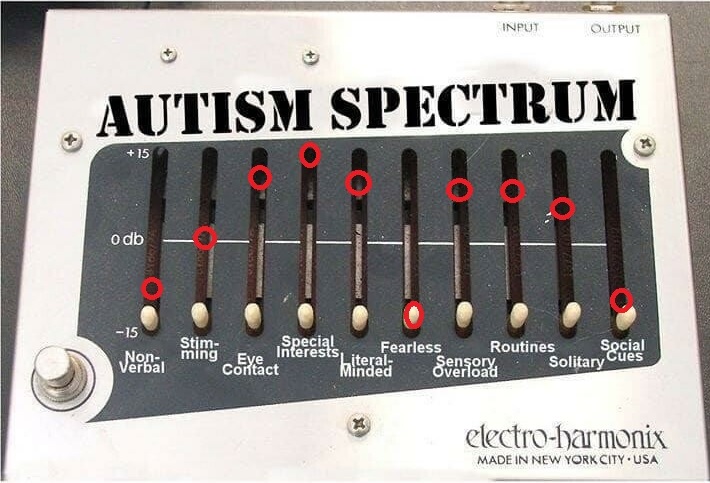
I know many people will look at that and say, well everyone is different, how is that autism? Autism is Neurodivergent, (as are Dyslexia and ADHD) meaning someone who is autistic is neurologically different from a neurotypical person. For me, some of those divergences are sensitivity to medications, sounds (in particular loud or cacophonous noise), foods (textures, minor toxicities such as food poisoning or hard-to-digest foods), and seeing complex connections in disparate things.
I’ll use two examples, routines and sensory overload. To be clear what I am writing here is literal.
Routines: If I have to do something next month, such as travel to a customer’s site out of state, it begins disrupting my sense routine from the day I schedule it. My routine feels disrupted even if I have nothing different to do today. It’s a nagging feeling of impending doom. I worry about it; I think through all the details of what I have to do to deal with it. What I need to bring, how I need to dress, flight times, and getting to the airport. All of those things flow through my mind from the moment I plan it.
Sensory Overload: An example of overload and what happens to me: I attended a lot of conferences, and there is always a social gathering at the beginning. Sometimes these gatherings are done in large spaces, and sometimes spaces I feel are too small that it’s hard to move about. If I don’t know many people there and I walk into a room that’s close and loud, I’m going to be stressed. If I attempt to be social with some folks and get rebuffed (they are waiting for others or whatever) I get stressed. If I can’t find a space to feel “safe” I get stressed. As these all build up in me, I get to the point of having to get out of the environment. I flee the space, sometimes almost in a panic. If I can get outside and it’s quiet, I might recover soon enough to go back in and try again. Other times I’ve had to go to my hotel room and call it a night.
Zoning Out
No discussion of my autism would be complete without talking about my ability to completely zone out. By that I mean I might catch onto a detail in a meeting, lecture, or phone conversation, and the greater part of my cognitive abilities will go off and wander around thinking about that detail. I’ll still be somewhat attentive to what’s going on, but not sufficiently to really contribute.
An example of one of those details might be someone saying, quite in passing, we’ll need to figure out how to lower the cost of hosting each instance of our SaaS clients. With that my CPU will be 95% engaged in thinking through each facet of our hosting platform and how we could reduce the costs. Servers used, operating systems, routers, firewalls, and database servers. Can we reduce database instances by running a more powerful server or will that just get us a CPU charge on top of the instance? How many instances can we run on our current database server, perhaps we are overpowered and underutilized, have to ask Ted when I see him.
Eventually, I’ll get asked a question I’m unable to answer. I’ll say something like, I’m sorry, can you rephrase that, I’m not sure what you are asking. Alas, most people know the person asking that was daydreaming, but I wasn’t, I was working on something for the company, just not quite at the appropriate time.
Attention to Detail
I will go into this in more detail throughout the article (of course I will) but I’d like to frame things first to give you a flavor of how details matter to me, how I see them, and how I react to them in an everyday situation. So for me walking into the cafeteria at work. Oh, they moved the chip display over a foot, I guess that gives more room at the grill. But they didn’t clean the floor where it was standing, that’s odd, I wonder if someone just bumped it? No, it wouldn’t move a whole foot if it was just bumped, and it’s pretty heavy, and it hadn’t moved ever before. Must have been on purpose. I won’t go on, but 30-40 other things are each looked at and observed while I move through the lunch line deciding what I want to get for lunch. And this is a place I have gone to hundreds of times before.
To cope with this obsession with the minutia of everyday environments, I study them and remember them. That enhances my ability to notice a change, but also makes it easier most days to just be able to walk into a situation, see all is as it was and still is, and move through it and do what I came to do. You may notice that this also parallels having a routine.
Since these details are remembered. I could tell you about the configuration of that room because my mind pulled in the details and recorded them. Not just for now, but permanently. I can still see the layout of the ETS cafeteria in Wood Hall and Conant Hall, and I last worked there 24 years ago. And the Wood Hall cafeteria closed years before that. It’s so long ago, I think Conant Hall has been razed and replaced.
Change of Employment
In my career, I had nine job changes. Of them, only one was forced because of a job loss. The others were partially my decision. I say partially because there was always an external stimulus. If not for the stimulus, I would have stayed until the business closed, or I was fired/laid off.
But I did change jobs. There are several hard parts, the first is actually going to the interview, I mean that literally, the energy it takes to move through all the steps to get into the interview for me is monumental. At any moment along the way, I could just “snap” and not go on the interview. Quite literally just turn around and not go. I’ve even turned around, then re-turned around and did that again until I finally ended up going through with the drive to the business, or maybe not. Then when I get to the business, the environment I walk into determines if I continue forward or not.
My point in all that was to illustrate how simply worrying about how I dress, how I look, and if I know enough to be able to get through the interview is not the barrier I face. Simply passing through all my hurdles to even get face-to-face with the person is far more daunting.
Once on the new job, I was able to make myself valuable to the company in many ways that weren’t on my employer’s radar. In every case, I rose up in the organization to fill a far more important part of the operation. Perhaps, not ironically, I could not see that, I always felt as if I was moments away from failure. Being called into my supervisor’s office filled me with dread. And in my 42 years of work, only once was that a termination of employment, all the other times I was going to be asked to do more, be paid more, or be told I was receiving some kind of reward. I never saw that coming and never felt important or part of the whole.
Work Travel
This rolls all of my issues into one big ball. It messes with my schedule, is often unpredictable, involves many things that are new, and thus overloads my senses, my solitude is generally lost or minimal. With time, I learned how to make travel work in my more rigid lifestyle. I had travel clothes, a Dopp bag that I kept prepped with my travel supplies, and a bag of liquids, all of these things ready to go so I could travel at a short notice. I also learned to pack into a flexible bag that could fit under the seat in front of me and fit all the commuter planes’ luggage area. Thus I never had to gate-check a bag.
I flew the same two airlines, from the same two airports and for most of my working career, was able to fly nonstop because Newark and Philadelphia are hubs for two major airlines. That mostly kept me from changing planes in an unfamiliar airport and simplified my travel. Thus I had one less worry.
One thing work travel did was brought me a lot of stimuli that often overwhelmed my senses. A silly example is one time I was in a cab going to the hotel and the road had interesting curbing and storm water drains. As I looked at them I imagined riding my bike on those streets. It worried me that my bike tire could get caught in the storm drain if I rode too close to the curb. This thinking filled my mind all the way to the hotel. I couldn’t get that thought out of my head. I finally went out to the street and looked at the storm drains, I concluded they were not a danger. But until that point, it worried me.
Holiday Parties
If there is anything that spells disaster for this autistic man it’s a holiday party. There is no upside potential, only downside. If I’m lucky, I’ll get through it without anyone noticing me and my discomfort. OK, I’m retired, that never happened it has always felt at least uncomfortable or a near disaster for my position in the company. These are situations where coworkers “let their hair down” and often interact in ways, unlike normal work interactions. For me, that created a situation where I thought I knew how to deal with a person and was then faced with often a totally different situation. Exceptionally disturbing as it breaks the pattern and structure I hold so dear.
The one that stands out is the restaurant we went to I had previously gotten food poisoning there on two different occasions. I crossed it off my list of any place I’d eat again. So, there I was for work. I got a glass of red wine and ate the bread dry because it was an olive oil dip (who knows, the bread is safe, the oil, maybe not) They took the orders and I passed. Am I OK, yes and I want to stay that way. I would have simply passed if it hadn’t been a secret and we didn’t carpool there. But I was stuck for the duration. So, I’m eating bread, trying to not get drunk, and hoping this ends soon. It was the longest three hours I’d ever spent in my life. Now, I attribute the hypervigilance to my autism, would a neurotypical person have just taken the chance and eaten dinner? I argue yes, they would have.
Questions?
If you have questions, or want to contribute your own story, please ask or post here. I’m sure it’ll help the conversation.
 Joe's Thoughts